Springe zum Hauptinhalt

Picking up Activity

The activity graph on a programming project management tool, kinda looks like a bathroom mosaic, with white tiles and as time passes a bunch of darker colored tiles

Many years ago two of my friends had started a little project for tracking of sports workouts. They had a nice little "proof of concept", which actually worked. Then, for many years, nothing happened and the project was forgotten. Except it still bounced around in my head, while me and my friends were busy with other projects.

The problem with projects like this is that there is some kind of "bit rot", or should we say "dependency rot". The project doesn't only consist of its own code, it depends on a bunch of other code bases, libraries, tools, etc. which invariably change over time. If you are not on the ball with your own project, suddenly it will stop installing or working, because a couple of the underlying libraries have changed. But I digress...

Then, I remembered that project again and started to pester my friend Wu to let us start with it again. The problem was that the code base I had was outdated, while Wu had some newer changes that he needed to apply. Also we needed a place to host the project to work on it. So at the start it was Wu who got busy, installing Forgejo on one of his servers, getting the git project set up, applying and testing his patches.

When that was done I started to dive in. At first with some code reading, some trying out, formulating some lists of tasks. It took me a while to get comfortable, but then it felt so good to be working with my friends again, especially on something that is our own thing and is enjoyable in itself. We called out to a close circle of friends who might join in, and Max jumped right in. With a lot of energy and knowledge.

Now I'm working almost every day a little bit on this. It's a hobby project after all. Programmers recognize the graphic at the top of this post right away: It's the "activity graph" of a project. Each square represents a day (the graph goes back one year, from left to right). Grey squares are where no work was done, Yellowish-reddish squares represent days with work done, the darker the more. So you can clearly see how the work has picked up after a long hiatus. And I'm sure it won't stop there ... "more to come" as they say.

The forgejo site is currently locked and password protected. On the one hand, we want to move the project a little bit more ahead before "presenting it". On the other hand, we're a bit cautious after reading all the stories of AI bots thrashing web sites and especially code repository sites. We don't want to feed the ghouls and we certainly don't want to deal with the bandwidth and server hassles. We will have to find a solution for this.

Ink Clouds

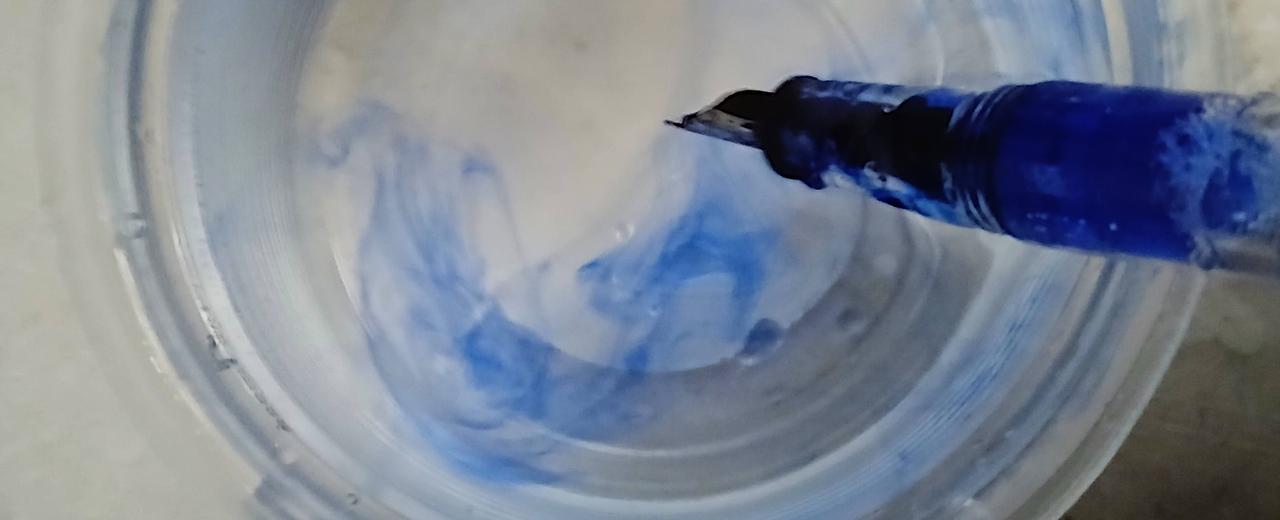
Ink clouds in the water while cleaning a fountain pen

Since moving house in late spring, there are a number of things that I still can't locate. They are either in one of the yet-unpacked boxes, or I've put them somewhere and lost track of them.

For some weeks now, I was looking for my bottle of super-duper document ink for one of my fountain pens. It's a "document" ink, which means it won't fade in the light, it's waterproof on the paper and other such nice attributes. But it's also a bit scary, because clogging up a fountain pen might be fatal. Regular cleaning is advisable.

Now for weeks I was sure I had unpacked this little bottle and placed it somewhere, probably separate from other things, and probably out of the light. I had the image of me placing it somewhere almost in my mind. Except, today when unpacking a few more small boxes, I found it. There seems to have been some cloudy images in my mind.

So it was time to clean the fountain pen, to get it ready to be refilled. One thing I really like about that is the ink clouds you get in the water when you repeatedly pump water in and out of the fountain pen. I tried to snap some pictures, but I would have needed a third hand. From a few not very impressive fotos, this was the best one.

"Abi Daré wins the inaugural Climate fiction prize"

The description of this book definitely sounds quite interesting.

Read the Article at the Guardian

Warum gibt es Wegwerfprodukte?

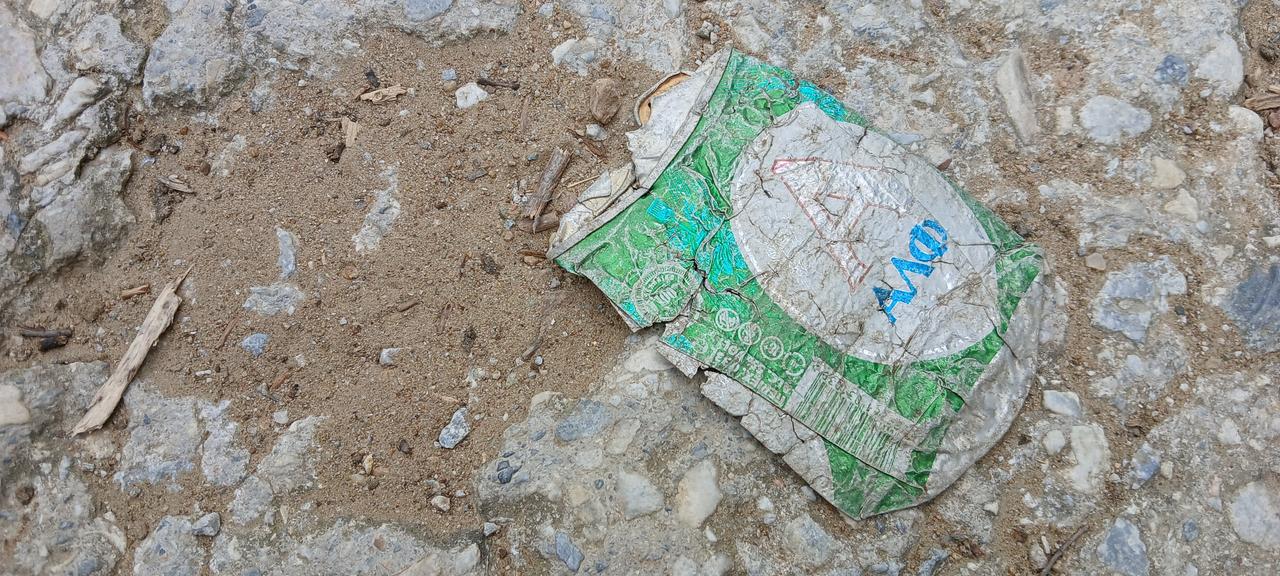
Eine plattgewalzte Bierdose aus Aluminium auf einem Feldweg

Der Grund warum wir überquellende Müllhalden, Mikroplastik selbst im innersten unserer Körper und Plastikmüll selbst auf den entlegensten Inselparadiesen haben ist ... billige Energie.

In einem etwas älteren Beitrag auf dem Blog des Schweizer Nationalmuseums mit dem Titel Eine kurze Geschichte der Kreislaufwirtschaft bin ich auf einen einfachen Gedanken gestossen: Dass es eben erst aus zwei Gründen möglich war, all diese Wegwerfprodukte zu produzieren:

  1. Die Industrielle Revolution

  2. Die billigen Erdölpreise seit den 1950er Jahren

Erst durch diese Entwicklungen machte es Sinn, einen Eimer eben nicht so zu produzieren, dass er es ein Leben lang aushält, dass wir mit seinem Wasser den Fussboden wischen. Jetzt kostet der Eimer 3.50, ist aus Plastik, das selbst bei Nichtbenutzung nach ein paar Jahren zerbricht. Über seinen Ersatz ("kurz einen neuen kaufen") und das was von ihm übrig bleibt, sollen wir uns möglichst keine Gedanken machen. Nur ich stehe dann da, mit den Bruchstücken des Plastiks in der Hand und frage mich, ob es überhaupt noch Sinn macht, die vergilbten Bruchstücke überhaupt noch ins "Recycling" zu schmeissen.

Ohne die Industrielle Revolution und die billige Energie wäre der Eimer teuer, weil handgemacht und aus verzinktem Blech oder sogar Holz. Vielleicht würde jeder Eimer ein wenig anders aussehen. Auf jeden Fall würden wir ihn ein Leben lang benutzen wollen ... nicht nur weil er teuer war, sondern auch weil er eben "unser Eimer" wäre. Der Mensch, der in gemacht hätte, würde vielleicht bei uns im Stadtteil leben oder im nächsten Dorf.

Ohne diese billige Energie, wäre auch das Bier in der Aludose nicht machbar, selbst die perfekteste Optimierung der Quartalszahlen für die Shareholdervalue wäre nicht durchsetzbar.

Ich denke dabei nicht so sehr an Nostalgie, als vielmehr daran, ob diese billige Energie wirklich so viel billiger ist. Wir zahlen für den Plastikeimer (und all die anderen Wegwerfprodukte) einfach nur kollektiv "auf später" die Rechnung. Falls wir sie dann noch zahlen können.

Diese Velosaison entwickelt sich für mich bis jetzt etwas wie Paris-Roubaix: Dauernd irgendwelche rauhe Streckenabschnitte ... und dann ein harter Kampf um wieder halbwegs den Anschluss zu schaffen.

What then, is the point?

On Ruben Schade's blog I came across his text titled What's the point? and this definitely interested me. Because I often ask this question ... mostly in my head. People tend to ask this question rhethorically as a way of saying that they do not see a point in doing something. That happens to me too, I admit. I mean, some people in our village going out with a gun and for one afternoon blasting lead bullets into the olive groves aka "hunting"... what's the point?

But I disgress. I do ask myself sometimes "what then, is the point of this?" in a positive way sometimes. Actually those can be some very productive moments. Asking myself what really is the reason why I do something. Or even asking myself what (I think) is really the reason why somebody else does whatever they do.

In Ruben's case, it lead to an interesting blog post about some of the things that interest him, and what is behind it. What a good question, really.

Drei Jahre ... drei Jahre des Unfassbaren. Drei Jahre Krieg. Ich bin immer noch fassungslos.

... innerhalb der planetaren Grenzen

Der Titel der Abstimmungsbroschüre für die Volksabstimmung am 9. Februar 2025 "Für eine verantwortungsvolle Wirtschaft innerhalb der planetaren Grenzen"

Eine Volksinitiative, die verlangt, "dass wirtschaftliche Tätigkeiten nicht mehr Resourcen verbrauchen und Schadstoffe freisetzen, als für den Erhalt der natürlichen Lebensgrundlagen erlaubt ist" steht dieses Wochenende in der Schweiz zur Abstimmung an. "Für eine verantwortungsvolle Wirtschaft innerhalb der planetaren Grenzen" oder kurz "Umweltverantwortungsinitiative" heisst das Ganze.

Chancen für eine Annahme sehe ich eher nicht. Was für mich im Moment aber nicht das Wichtigste ist (nein, nein, natürlich wäre es meiner Meinung nach sehr gut und wichtig, wenn diese Initiative angenommen würde). Für mich ist es nur schon ein Lichtblick, dass diese Initiative zur Abstimmung gelangt ist. Das gesellschaftliche Momentum, dass es dafür braucht, dass so etwas da ist, das tut gut. Vom Sammeln der nötigen Unterschriften, zur Kampagne, selbst zur (von weitem gesehen eher minimalen) Präsenz in den Medien: Das ist doch mal etwas ganz anderes als das "der Klimawandel ist in den Bundestagswahlen kein Thema" in Deutschland.

Im Abstimmungsbüchlein steht:

"Die Initiative setzt eine Frist von zehn Jahren

[...]

Der Initiativtext lässt die genauen Massnahmen zur Umsetzung, wie Vorschriften, Verbote und Anreize für einen umweltverträglicheren Konsum, offen. Wegen der kurzen Frist dürften einschneidende Instrumente notwendig sein."

Hervorhebung von mir. Dieser Text stammt nicht von den Initianten, den schreibt irgendjemand in der Staatskanzlei oder so. Der Teil, den ich fett hervorgehoben habe, ist sehr wahrscheinlich absichtlich als Abschreckung da rein gerutscht.

Aber das ist gar nicht so unpassend. Es deutet immer mehr darauf hin, dass wir die 1.5°-Hürde jetzt schon übersprungen haben. Es wird jetzt nicht mehr damit getan sein, Industrieprojekte grün anzumalen und den Leuten ihren von der Ölindustrie erfundenen "carbon footprint" vorzuwerfen. (Dass da "Anreize für einen umweltverträglicheren Konsum" steht, zeigt uns, wie tief verankert dieses Denken ist, dass die Leute halt nur mehr Recycling von Joghurtbechern machen sollten, dann wird schon alles gut. Wie verinnerlicht das "carbon footprint"-Denken bei solchen Leuten ist.) Egal ob mit dieser Initiative oder anders, wir werden uns früher oder später darauf einstellen müssen, dass "einschneidende Instrumente" nötig sein werden.

Οι σεισμοί...

A map screenshot with the quake locations, taken some days ago, from allquakes.com

Εδώ ρωτάνε πως τα πάμε στην Νάξο με τους σεισμούς; αν κουνάει;

Πρέπει να πω ότι μια χαρά είμαστε. Βεβαίως και κουνάει εδώ και μέρες. Ακούμε τα ποτήρια στην ντουλάπα και ξέρουμε: άλλο ένα πάνω απο τέσσερα ρίχτερ.

Αν όχι τίποτα άλλο, γλυτώνουμε το ρεύμα για το μίξερ. Αν θες να φτιάξεις φραπέ, απλά βάζεις τα υλικά σε ένα ποτήρι (ένα λιγότερο που τρέμει στην ντουλάπα τώρα) και το αφήνεις στο τραπέζι για κάνα τέταρτο. Ε βουαλά (όπως λένε οι Γάλλοι που δεν έχουν σεισμούς) τον χτύπησε τον φραπέ ο επόμενος 4.8.